
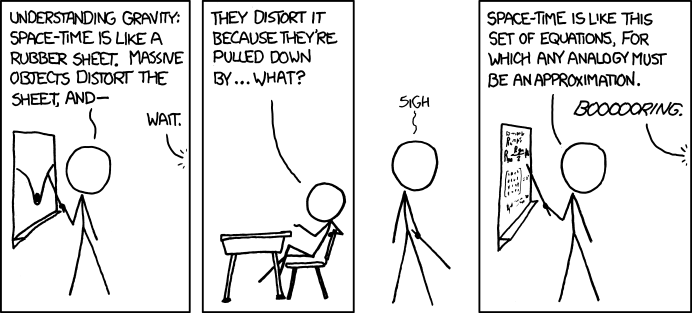
I think the bigger and deeper question here is: does it really matter? As a scientist, I understand the need for precise language and avoiding simplifying analogies when it can do harm to your discussion. Simple analogies, though useful as a pedagogical tool, can often backfire when students get further along in their studies.
My philosophy is that this isn't as big of an issue as we'd like to make it. Sure, these simplifications can fail when viewed too rigorously. It can even cause issues to students advancing further in the field. I think these risks are outweighed by the possible benefits of spreading appreciation of science. Too often, science is viewed through this lens of mystification, where those non-initiated view it as a sort of 'magic', and the people who study it are typically socially awkward at best, if not downright mad.
Quiz: How many times have you seen a scientist or mathematician on TV who follows a sports team, or goes to a bar to hang out? Answer: Will Hunting.
I think one of the best things we can do is use the forum of the classroom to help people understand that, although it is shrouded in equations and theorems, science can really just be common sense. That's part of what's so great about it. It works.
A good analogy can really change how students view a concept. Sure, it may be a non-rigorous explanation, and sure it can lead to misconceptions down the road for scientists-but people interested in science will get past this! We will read papers and books detailing the inner workings of a system, and obtain a full understanding. But to a student that will not become a physicist or chemist or biologist, this rigor is not what is important. What is important is looking at problems and thinking about them analytically, and using our minds to accomplish our goals. For these students, a good analogy can really bring about a shift in thought and encourage growth, whereas the rigorous explanation may just turn them off altogether. Science begins to make sense, based simply on everyday experiences.
And once it begins to make sense, science isn't really that scary.


No comments:
Post a Comment